Style Transfer Progress
I made a longer version of the prototype I showed in my Midterm Status post. This took a week to complete:
Our first assignment for Collaborative Design is to brainstorm a use case for a potential AI-related project. We needed to define the use case and articulate personas to motivate the product design.
Collaborative Design: How to Build Products in the Age of AI, taught by Marc Maleh and Marc Blanchard.
Class blog posts:
In the second half of the class we will learn about the wood lathe. The lathe has been around for over 3000 years, first invented by the ancient Egyptians. The device would be operated by 2 people with one person turning the wood with a rope. These days the rotation is powered by a motor.
I was feeling nervous about this skill builder so I watched some instructional videos on YouTube. This one was my favorite:
She's my hero.
Charles Atlas (b. 1949) is an American video artist and filmmaker who was and is a pioneer in his field. He has collaborated extensively with other artists throughout his career and made innovative video installations and art.
Anri Sala (b. 1974) is an Albanian-born artist who uses video and sound to create complex works of art that emanate from the painful history of his home country and its Communist past. His work demonstrates careful attention to detail and a sophistication of thought and subtlety.
Sala studied painting at the Albanian National Academy of Arts from 1992 to 1996 and later studied video in Paris, France at the École Nationale Supérieure des Arts Décoratifs from 1996 to 1998. His pivotal work, Intervista—Finding the Words (1998), was made when he was still a film student in Paris. To produce this work he found 25-year old video footage featuring his own mother at a Communist rally in Albania. The found footage had no audio so neither he nor his mother had any idea what was being said. He then was able to get a deaf person skilled at lip reading to watch the video and recreate the transcript. Using the transcript he could tell his mother what she said. Her reaction to her own words was one of shock and disbelief. Anri said of his mother’s words, “if you hear it 25 years later you are surprised and saddened by the stiffness of the language.” The work confronts Albania’s painful history in a powerful way.
Nick Mauss (b. 1980) is a multidisciplinary artist who makes performance art, drawings, and paintings. His career pursues a hybrid role of artist, curator, and scholar. His exhibition at The Whitney, Transmissions, demonstrates this as he explores the relationship between ballet and avant-garde visual artists from the 1930’s to the 1950’s.
Mauss graduated from Cooper Union in 2003 and now lives and works in New York and Berlin. He has taught art at Hochschule für Bildende Künste in Germany and Bard College in New York.
Bill Viola (b. 1951) is an NY-born video artist whose work addresses fundamental human experiences such as birth, death, and consciousness. His work frequently uses water to explore these themes.

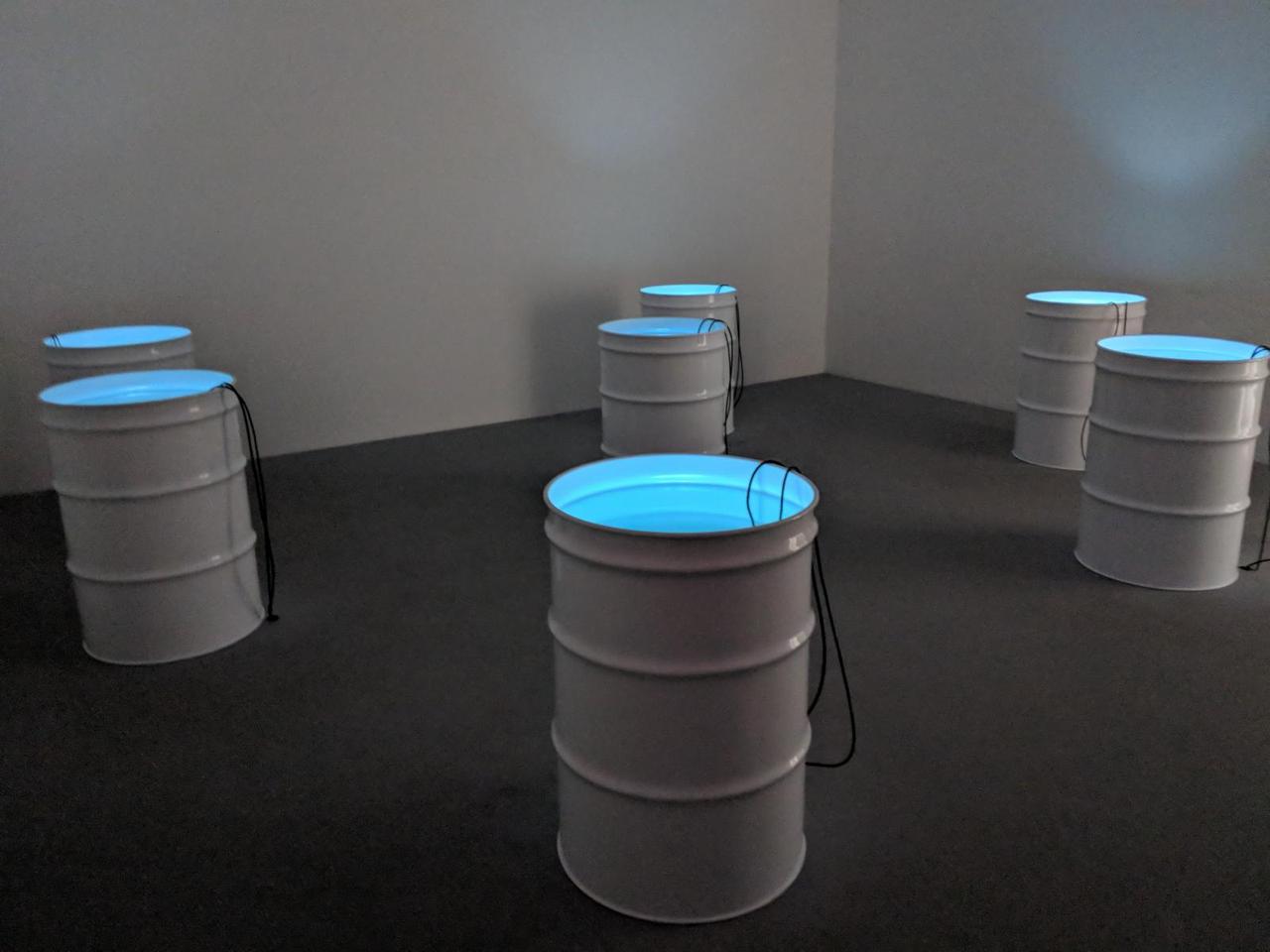
The Sleepers (1992), by Bill Viola
The pivotal moment in Viola’s life is when he was 6 years old and fell to the bottom of a lake. His uncle saved him from drowning, but while in the lake Viola experienced what he later described as “the most beautiful world he’s ever seen.” His work, which often involves water, is influenced by this experience. In his words, “I see it [the bottom of the lake] constantly almost in my mind in my mind's eye. It was a kind of paradise…”
Our class is half over and it is time for our midterm full-class feedback session. I've made a lot of progress recently and am excited to share my work with my fellow students. I will definitely achieve my original goals for this class, however, if that's the only thing I do with this, it would be a crime. This project is absolutely going to live on long after this class is over.
The 60's and 70's brought about significant changes in the kind of music being written by composers. This was partly motivated by advances in technology. There was a growing influence of non-western cultures. Composers were also turning away from traditional institutions and schools of thought for leadership and artistic vision.
I worked with fellow student Ethan Helm to create a short presentation on Minimalist Composers of the 60's and 70's to share with the class. He is a saxophonist and composer and knows a lot more about music than I do. Collaborating with him on this was educational.